Wednesday, October 1, 2014

Ho Chi Minh City launches a new rowboat tour to downtown canal

Ho Chi Minh City plans to introduce rowboats to allow tourists to travel an attractive downtown portion of the Nhieu Loc-Thi Nghe canal starting this December.
The itinerary will be rowed along the canal between the Saigon Zoo and Vinh Nghiem, one of the biggest pagodas in the city, which usually hosts religious exhibitions and festivals.
A one-way trip will take around two hours and each boat will be able to carry 20 passengers. The boats will run every day from early in the morning to 11pm when conditions allow, the canal is not very wide, around 60 meters, which makes a rowboat suitable
Propelling a boat with oars will also provide an interesting experience for tourists. The canal trip will be included in tours around the city
Ho Chi Minh City currently offers seven canals and river tours and is building necessary wharves and piers to further develop waterway tourism.
Nguyen Viet Anh, head of the travel office at the HCMC Department of Tourism, Sports and Culture, said eight to ten new piers will be put in used by the end of this year.

Vietnam promotes tourism in Norway

The Vietnamese Embassy in Norway recently organized a workshop to promote the country as a tourism destination in the northern European market.
The workshop was part of a campaign to increase the number of Norwegian tourists to Vietnam and enhance people-to-people exchanges, thus contributing to the two countries’ bilateral friendship and multi-faceted cooperation.
Ambassador Le Thi Tuyet Mai introduced the unique cultures and popular destinations in Vietnam to participants, with a special focus on natural and intangible cultural heritages that won UNESCO recognition.
The diplomat also highlighted the visits to Vietnam by King Harald V and Queen Sonja in 2004; and Crown Prince Haakon Magnus and Crown Princess Mette Marit in March 2014.
Traditional Vietnamese dishes were also featured in the workshop.
She said she hoped more Norwegian visitors would come to explore Vietnam and its culture to increase mutual understanding between the two countries’ and enhance their partnership.
Norwegian representatives described Vietnam as a new attractive destination for international holiday-makers.
Vietnam now has seven world intangible heritages listed by UNESCO: Hue ‘s royal court music; Gong space culture in the Central Highlands ; Quan Ho (love duet) singing; the Giong festival; Ca Tru ceremonial singing; Xoan singing; and Worshipping the Hung Kings.
The country is home to numerous UNESCO World Heritage Sites, such as Ha Long Bay, Hoi An ancient town, and Hue imperial city. Most recently, the Trang An Tourism Complex in northern Ninh Binh province was recognized as a cultural and natural heritage sit

Monday, August 25, 2014

Tay Ninh - weekend destination in the Southeast Region
About 100 km from Ho Chi Minh City, Tay Ninh is an interesting destination for weekend.
Conquering the roof of the Southeast
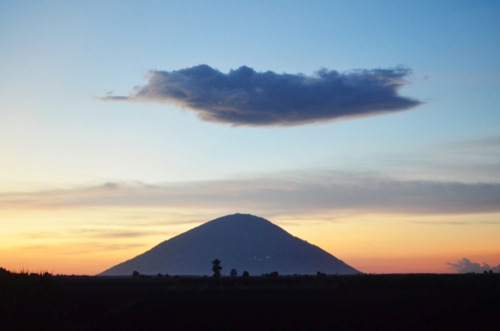
tay ninh, holy see, dau tieng lake, ba den mount
Ba Den Mount.
About 11 kilometers northeast of Tay Ninh City is the Nui Ba relics spanning 24 km², including the three mountains named Heo (Pig) – Phung (Phoenix) - Ba Den.
There are many temples in this area, including Ha, Trung, Thuong, Hang and some temples inside caves. In order to visit these temples, visitors can walk or use the cable car system or slide pipes.
For those who love exploration, to go to the roof of the Southeast region at the elevation of 986m, the only means are their legs.
Tay Ninh Holy See
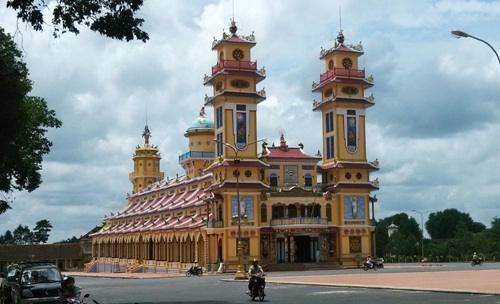
tay ninh, holy see, dau tieng lake, ba den mount
Located in the district of Hoa Thanh, about 5 km south east of Tay Ninh City, Tay Ninh Holy See has unique architecture.
The campus is up to 1.2 km2 with a lot of religious architectures connected with each other by wide roads, with rubber trees alongside.
The Holy See building is 140m long, 40m wide, with three 36m towers, two bell towers of 25m high and dozens of towers of 30m high.
Inside the building are two rows of dragon-shaped pillars. On the ceiling are nine skies with clouds and stars.
Dau Tieng Lake
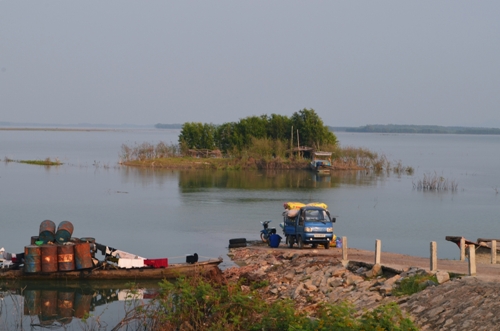
tay ninh, holy see, dau tieng lake, ba den mount
About 20km from the city of Tay Ninh, Dau Tieng Lake covers an area of over 27,000 hectares and contains 1.5 billion cubic meters of water. The lake not only provides water to hundreds of thousands of hectares of agricultural land but it is also a tourist attraction.
There are many small islands in the lake. With beautiful natural landscape and the cool air, the lake is a favorite destination for nature lovers and photographers.
Enjoy the specialties of Tay Ninh
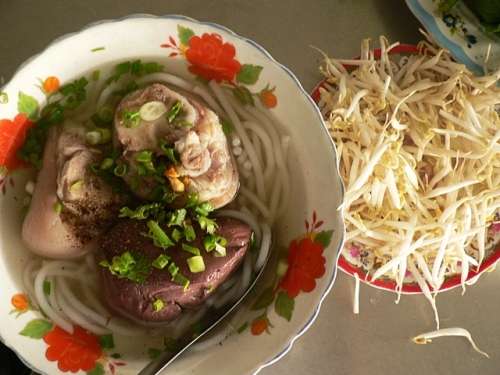
tay ninh, holy see, dau tieng lake, ba den mount
Trang Bang rice cake is the most well-known specialty of Tay Ninh.
Other must-try cuisines include banh canh gio heo (pork noodle) and Nui Ba snails.
You can also buy some specialties of Tay Ninh such as shrimp salt or rice cakes.

Tuesday, August 19, 2014

UNESCO LISTS DON CA TAI TU OR VIETNAMESE FOLK MUSIC AS WORLD CULTURAL HERITAGE

Since long ago, Don ca tai tu (Amateur singing) in southern Viet Nam has been rooted in the cultural and spiritual life of the southern people. On December 5, 2013 the art of Don ca tai tu was officially recognized as an intangible cultural heritage of humanity by UNESCO.


Mentioning Don ca tai tu, people often think of a unique folk art which is seen as a “specialty” of the southerners. People in the south, regardless of the rich or the poor, male or male, old or young can perform Don ca tai tu anywhere and at any time. Therefore, this musical art is performed at parties, in the orchard gardens on moon-lit nights, on the boats drifting along the green canals or at rituals, weeding, funerals and death anniversaries.
According to researchers, Don ca tai tu appeared in the late 19th century. It originated from Hue court music and soon became a gene of traditional folk music with the popular nuance of the southern watery area.
The word “amateur” in Don ca tai tu refers to an artist who is excellent in ancient music and has a special talent for playing the instruments and singing. It does not mean “unprofessional”. It means that the “amateurs” perform not to earn their living but to amuse themselves when they are happy and nobody can spend money buying their performance. However, their performing skill is not low because they have to practice diligently and create their own style. This musical art does not have its own performance costumes and the performers are not finical about the costumes. They only pay attention to dressing to suit the performance space when they perform at communal houses, temples or on stage.

According to Professor Tran Van Khe who has devoted his life to introducing the traditional music of Viet Nam in general and Don ca tai tu of the south in particular to the world, in the early 20th century Don ca tai tu developed strongly and quickly spread throughout the six provinces of the south. At that time, due to the interaction and emulation among the amateurs’ groups, their performing techniques were improved and the recording and systemization of the ancient songs were perfected. Many well-known artists in the Don ca tai tu circle in the south emerged, typically Nguyen Quan Dai (or Ba Doi) in Long An, Tran Quang Quon (or Ky Quon) in Vinh Long, Moc Quan Nguyen Trong Quyen in Can Tho, Le Tai Khi (or Nhac Khi) and monk Nguyen Chieu in Bac Lieu. These artists were accredited with promoting this art form to develop strongly in the first half of the 20th century.
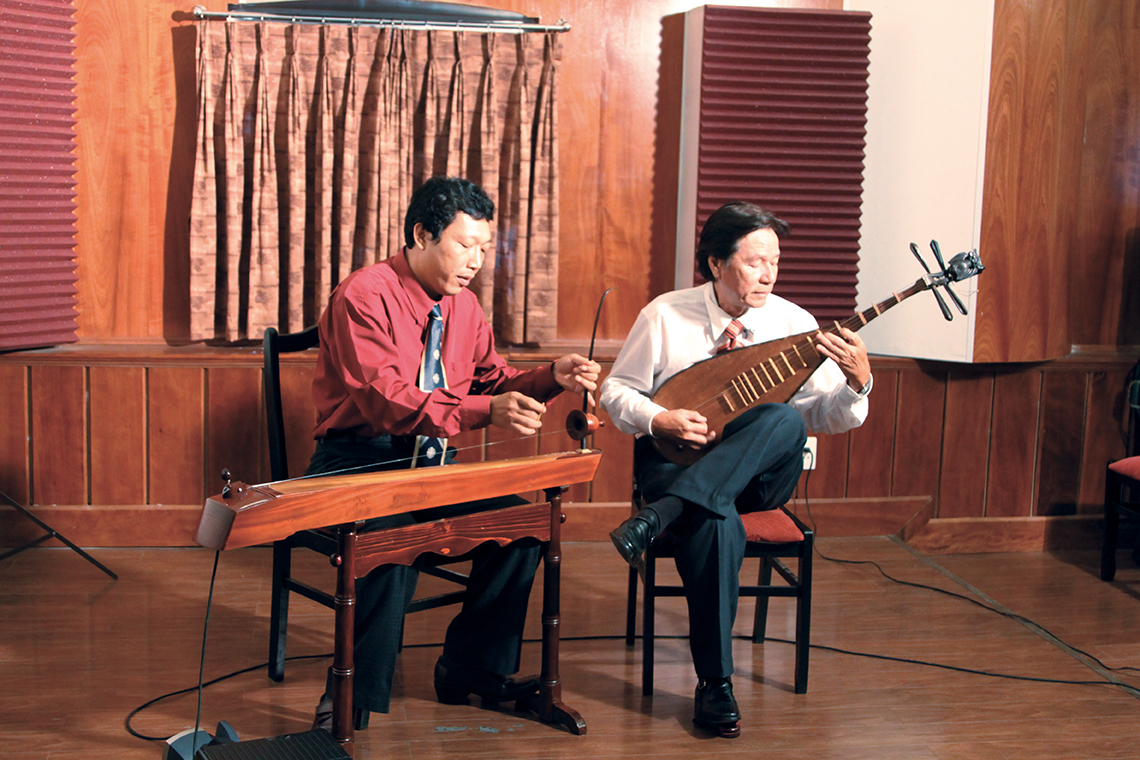
The main musical instruments in Don ca tai tu include the moon-shaped lute, the two-stringed fiddle, the 16-stringed zither and the monochord, which are known as the “four major instruments”. In 1930, the guitar, violin and Hawaiian guitar were added. The Song lan (percussion) was also used for beating time. Traditionally, the instrumentalists rarely perform solo, but they perform duets (on moon-shaped lute and 16-stringed zither) or trios (moon-shaped lute, 16-stringed zither and two-stringed fiddle), sometimes on the flute. The most interesting part of the Don ca tai tu performance is the prelude of the instrumentalist and the recitatives of the singer to tune the instrument and inspire the performer, creating the atmosphere for the band. In the impromptu performance the singers often perform with their own style after the original based on the traditional music. It is their elements that create the new and appealing features of the performance.
Don ca tai tu has many different songs but in general it has 20 major songs called “Nhi thap huyen to ban” for four tunes, including six Bac songs expressing joy and broad-mindedness, seven Ha songs used in the solemn rituals, three Nam songs expressing comfort and elegance and four Oan songs describing the scenes of sadness, sorrow and separation. Additionally, there are eight Ngu songs, ten uninterrupted songs, many variants and new songs composed by maestros and talented artists.
For over a century, Don ca tai tu has existed, developed sustainably and become a daily spiritual food. It is also a “specialty” that the southern people use to treat the visitors to the southern watery area.

Vitality of Don ca tai tu. Unlike many types of folk songs, Don ca tai tu has a strong vitality. Not only domestic but also foreign tourists who visit Viet Nam love this art from because of its rustic, familiar, romantic and unique characteristics.
Professor Tran Van Khe said that in 1963, he asked musician Nguyen Huu Ba to record a single disc of Don ca tai tu to introduce to UNESCO. In 1972, he sent to UNESCO the second disc of this music performed by him and professor of music, Vinh Bao. Cocora Radio France invited Prof. Tran Van Khe and professor of music Vinh Bao (in 1972) and 16-stringed zither artist, Hai Phuong (in 1994) to record another two discs which were listed in the best-selling albums in France and were awarded the music critic award of the year.
We came to Bac Lieu Province, an area with a strong Don ca tai tu movement in the south. It is also the native land of musician composer Cao Van Lau who is the author of the song “Da co hoai lang” (Night drum beat causes longing for absent husband), a symbolic heritage of the Don ca tai tu village in Bac Lieu Province.
Every hamlet, village, commune, ward and city in Bac Lieu has Don ca tai tu clubs. At present, the province has 227 Don ca tai tu clubs with 2,143 members including 475 instrumentalists and 1,668 singers. Of these clubs, 55 clubs have been provided with equipment and tools for activities by the State. All clubs have periodic activities. Every year, Bac Lieu organizes a Don ca tai tu festival, providing more opportunities for the clubs to perform and enhance their professional skills.
For over 10 years now, Bac Lieu, Soc Trang and Ca Mau Provinces along with some southwestern provinces have annually organized a musical exchange to promote the Don ca tai tu movement to develop.
Nguyen Quoc Minh, Director of Cultural Centre and Chief of the Department of Culture in Bac Lieu City said that the community training course on “Singing the Da co hoai lang (standard version) and Vong co (Longing for the drum beat) organized by the centre was attracting a large number of people of all ages, including elderly people who are over 80 years of age and teenagers.
Le Thi Thu Thao, a 14-year-old girl in Nha Mat Ward said: “I like Don ca tai very much because since I was little I have heard a lot of songs performed by my parents, my mother’s sister and brother in the family’s events or at parties. I learn hown to take a breath and keep the rhythm so that I feel more confident when singing.”
With its achievements and proud tradition in the development of the Don ca tai tu art, Bac Lieu Province has been chosen to host the first Don ca tai tu festival in Viet Nam by the State. The festival will take place in April 2014 with the theme “Don ca tai tu – The inner voice of the southern people”.
To prepare for this event, a part from continuing the conservation and promotion of the Don ca tai tu movement, Bac Lieu has built and repaired 26 keys projects, typically the commemorative area for the southern Don ca tai tu and musician Cao Van Lau, the cultural and artistic exhibition center and Cao Van Lau Theature, and the Hung Vuong Square.
According to the latest statistics, the Don ca tai tu movement has spread to 21 cities and provinces throughout the country and has 2,258 clubs with 13,800 members, of whom the youngest is six years old and the oldest is 99 years old.
Besides the strong development of the Don ca tai tu movement, attention and large investment have been given to the research and training of this art form in a professional way. Ho Chi Minh City is the largest center for the training and research on Don ca tai tu in the country. Here, there are two units which can train professional artists in this art. They include the Traditional Music Faculty of the Ho Chi Minh City Conservatory and the Traditional Music Faculty of the Ho Chi Minh Conservatory and the Traditional Drama and Song Faculty of the University of Drama and Cinematography. There are also many Don ca tai tu classes opened by the house of culture in the city and districts and by the artisans to teach those who love this art.
It can be said that Don ca tai tu is the “soul” of the southern cultural heritage. It is not only an art form which shows the cultural traits as well as the simple, friendly, generous and affectionate personality of the southern people but also has a high ability to attract and connect the community, so it always has a strong vitality and exists immortally with the cultural life of the nation./.
Visit us at: http://www.indochinadiscoverytravel.com/travel-news/63/unesco-lists-don-ca-tai-tu-or-vietnamese-folk-music-as-world-cultural-heritage

Friday, August 15, 2014

UNESCO lists Vietnamese folk music as world cultural heritage

The art of Don Ca Tai Tu's music and songs in southern Viet Nam has officially become a recognised UNESCO Intangible Cultural Heritage of Humanity.

UNESCO announced the decision yesterday (Dec 5), during the on-going 8th Session of the Intergovernmental Committee for the Safeguarding of the Intangible Cultural Heritage in Baku, Azerbaijan.
Known as a musical art that has both scholarly and folk roots, Don Ca Tai Tu (amateur singing) developed in southern Viet Nam in the late 19th century.
People in the south consider it an indispensable spiritual cultural activity and a highly valued part of their cultural heritage, which is performed at numerous events, such as festivals, ‘death anniversary' rituals, and celebratory social events. The audience can join in, by practicing, making comments or creating new words for songs.
The culture ministry's Cultural Heritage Department, said the music genre had met with the criteria to be included on the Representative List of the Intangible Cultural Heritage of Humanity.
It has been transmitted from generation to generation through official and unofficial forms of education in all 21 provinces, where the art form is popular. Don Ca Tai Tu has continually been popularised through cultural exchanges among peoples, presenting their mutual harmony and respect.
The art form is played on a variety of different instruments, including the kim (moon-shaped lute), co (two-stringed fiddle), tranh (16-string zither), ty ba (pear-shaped lute), song lang (percussion), bau (monochord) and sao (bamboo flute), and the violin and guitar, which were adapted.
The musicians who contribute to Don Ca Tai Tu include master instrumentalists, master lyricists, master singers, instrumentalists, and singers.
According to The Thao&Van Hoa (Sports&Culture) newspaper, UNESCO hoped that with this honour, Viet Nam will continue implementing protection solutions to support local communities in the word of mouth transmission and official education syllabus. These activities should be carried out with the active participation of local people, experts, relevant organizations, as well as proper assistance from the State.
In a document sent to UNESCO, the Cultural Heritage Department reported that from 1997 to the present, the government has provided funds for the inventorying, collection and documentation of the music genre and supported Don Ca Tai Tu ensembles, clubs and families to organise the transmission of the art.
"During our survey tour, we listed 21 provinces in the south of Viet Nam that normally perform Don Ca Tai Tu. Among which, the Cuu Long (Mekong) Delta provinces of Long An and Bac Lieu reported the appearance of the music genre for hundreds of years," said the director of Viet Nam Institute of Musicology, Dr. Le Van Toan, as the inventory was completed.
"It is an impromptu art performance to show off the creativeness and artistry of the performers. They use art to serve their daily lives, not to earn a livelihood. That's why this music genre is much adored by the Southerners.
"To meet UNESCO's criteria, we worked with artisans and Don Ca Tai Tu organisations to complete the localities possessing the music form. The inventory was completed with the scientific consultancy from leading experts, including Prof. Tran Van Khe," Toan said.
With this honour, Viet Nam expects to increase respect for a valuable form of performance, encourage the community to recognise the value of cultural heritage, and to voluntarily take part in practising, developing, transmitting and safeguarding it. Further, it hopes to strengthen community cohesion and support the cultural identity of local people through musical exchanges.
By confirming its international cultural value, Viet Nam also expects to enhance international cultural co-operation and exchanges through transmission, dissemination, and education, as well as enhance the awareness and responsibilities of communities, local authorities and the State concerning the research, documentation, practice, transmission and study of cultural heritages.
Traditional Japanese Washoku cooking methods, millenia-old Georgian wine-making techniques and the Mediterranean diet were among 14 new entries added to UNESCO's list of "intangible heritage" in need of being preserved.

UNESCO entries
Envoys picked the new listings at a meeting in the Azerbaijani capital Baku, UNESCO said in a statement late on Wednesday.
They include the traditional use of the abacus for counting in China and a Christian festival in the French region of Limousin that involves holy relics being paraded before worshippers once every seven years.
Other additions are Belgian horseback shrimp fishing; the annual pilgrimage to the mausoleum of Sidi Abd el-Qader Ben Mohammed in Algeria; Taureg Imzad music; Jamdani weaving in Bangladesh; the Cirio de Nazare religious festival in Brazil; Sankirtana music from the Vaishnava people in India; a central Italian Catholic procession; an Orthodox holiday in Ethiopia and a Kyrgyz epic poem.
A naming tradition common amongst the people of Western Uganda and Mongolian calligraphy also made the list earlier Wednesday.
Established in 2008, the Intangible Cultural Heritage list comprises some 100 traditional events from around the globe and is designed to "help demonstrate the diversity of this heritage and raise awareness about its importance," according to UNESCO.

11 Incredible Terrace Fields


In order to make the best of poor soil, water conservation, and mountainous terrain, terraced farming was introduced by various cultures around the world. Extremely labor intensive to build, terracing allowed the land to support civilization’s increased need for crops, livestock and poultry. Erosion was avoided, rain and runoff water was preserved, and otherwise unused hillside became arable due to terraced agriculture. Not only do these terraced fields provide essential goods for the local people but they also feature some of the most spectacular landscapes in the world.

11Sa Pa Terraces
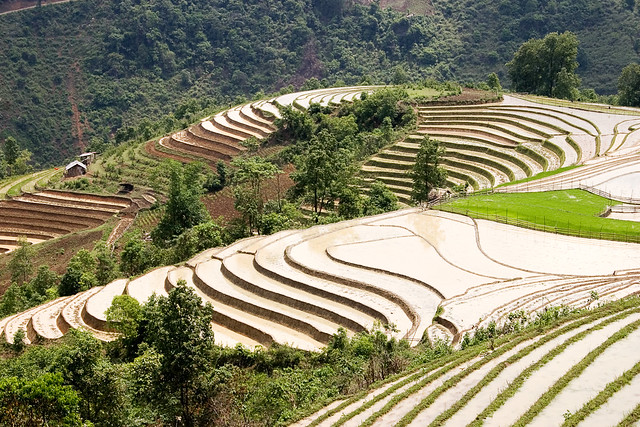
Sa Pa is a town in northwest Vietnam not far from the Chinese border. The rice terrace fields, among the most popular tourist attractions in Vietnam, can be found in the Muong Hoa valley between Sa Pa town and the Fansipan Mountain, on a backdrop of thick bamboo woodlands. Local mountain people, the Hmong, Giay, Dao, Tay, and Giay, grow rice and corn on these paddy terraces, along with vegetables. Because of the climate, only one rice crop a year can be produced, resulting in abundant malnutrition.


10 Pisac

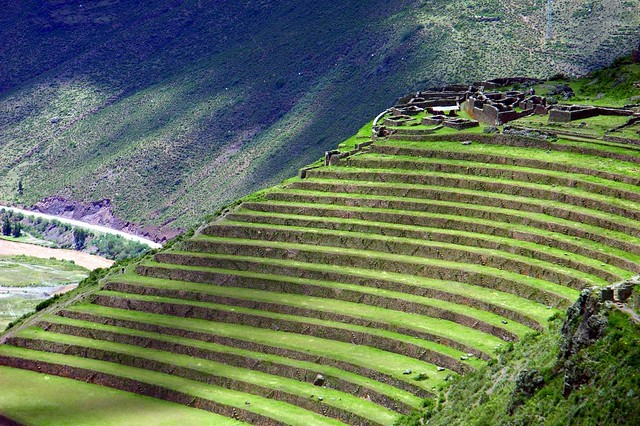
The still intact terrace fields of Pisac, constructed by the Incas, are still being used today. These mountainous terraces consist of 16 different cultivation sections. Pisac, a word of Quechua origins, means “partridge”. Inca tradition dictated building cities in the shape of birds and animals, and as such, Pisac is partridge shaped. The Pisac terraces included a military citadel, religious temples, and individual dwellings, and overlooks the Sacred Valley, between the Salkantay Mountains. These terraces even boated two suspension bridges, the bases of which can still be seen.


9 Douro Valley


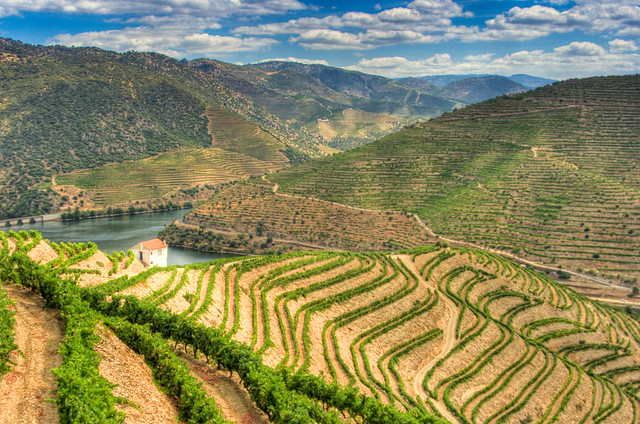
The home of port wine, the Douro Valley is located in northern Portugal, some distance from the city of Porto. The hills of the valley are covered with terrace fields of vines falling steeply down to the river banks. The scenery of the valley is spectacular with the colors of the land changing throughout the year as the vines mature. In autumn the vines take a reddish and golden color, while in February-March the almond blossom gives an added white pinkish tone to the region. As well as port wine, regular red and white wines are also produced in the valley.


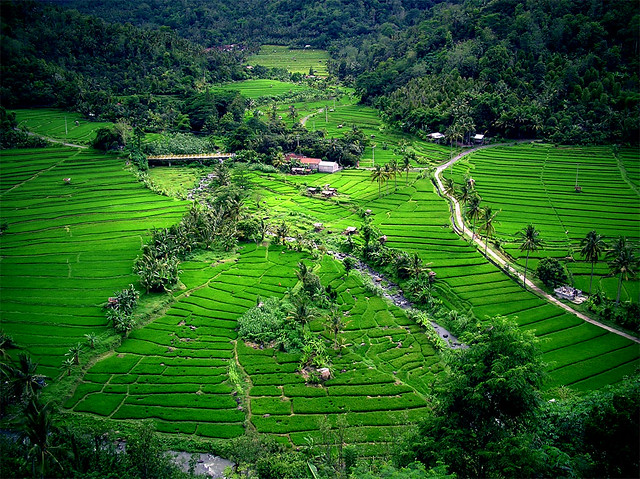
8 Bali Rice Terraces


The archetypical Bali rice terraces are ubiquitous, and Balinese culture has depended on this method of agriculture for almost 2000 years. The Balinese stepped rice paddies were carved by hand, with rudimentary tools, and maintained by succeeding generations.
In central Bali, north of the village of Tegallalang in the Ubud district, lies a series of thriving stepped rice paddies, a favorite with travelers and photographers. Other verdant terraced rice paddies can be found in Sayan, Jatiluwih, Pupuan and Tabanan. In Bali, the terraced rice paddies are worked according to a well organized social order, called a subak. The subak manages the irrigation water sources, on a strict schedule, fairly distributing the water.


7 Choquequirao


Another Peruvian stepped agricultural site is Choquequirao, meaning Cradle of Gold. Seated on the border of Cuzco and Apurimac, this impressive terraced site, is located 3085 meter (10,120 feet) above sea level. Choquequirao contains a staircase configuration, made up of 180 terraces. Built in a completely different style than Machu Picchu, Choquequirao is much larger in area. One can only travel to Choquequirao by foot or horseback, and as such, is visited much less often than Machu Picchu. Without benefit of wheels, the trek to Choquequirao from Cachora can take up to four days!


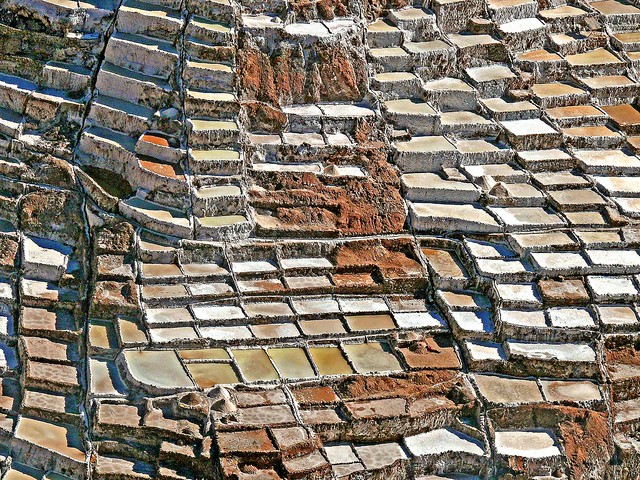
6 Salinas de Maras


The Salineras de Maras, or Inca salt pans have been used for centuries. Salt miners direct natural spring water, containing high concentrations of salt, into the man made terraced flats, numbering around 3,000. This spring water becomes saline by leeching salt from the mountain itself. When the water is evaporated by the sun, thick salt deposits remain. The salt is then cut into huge slabs and transported to the markets. As in some of the Asian rice paddies, these salt pans are passed from generation to generation, and have been in use for centuries. If you plan on visiting, visit in the late afternoon, when the reflected sunset causes the salt pans to appear as if made of gold.


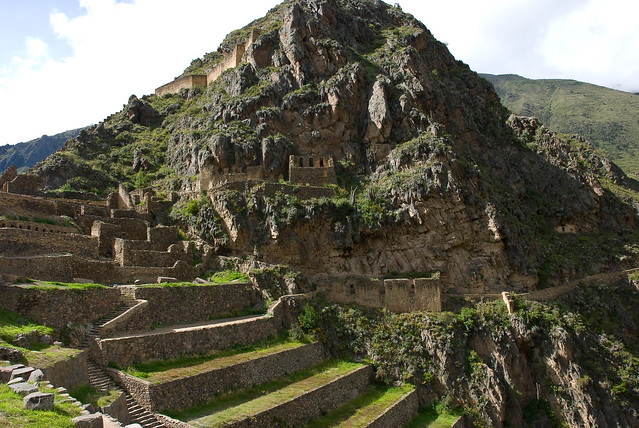
5 Ollantaytambo


During the Inca Empire, Ollantaytambo was the royal estate of Emperor Pachacuti who conquered the region, built the town and a ceremonial center. At the time of the Spanish conquest of Peru it served as a stronghold for the Inca resistance. The valleys along Ollantaytambo are covered by an extensive set of agricultural terraces which start at the bottom of the valleys and climb up the surrounding hills. The terraces permitted farming on otherwise unusable terrain. Nowadays Ollantaytambo is an important tourist attraction and one of the most common starting points for hike known as the Inca Trail.


4 Longji Terraces


The Longji or Dragon’s Backbone rice terraces were built over 500 years ago during the Ming Dynasty. The terrace fields are found in Longsheng about a two hours drive from Guilin. From a distance, during the growing season, these winding terraces appear as if they were green woven cables laid out over the hillsides, starting at the riverbank and ending near the mountaintop. One can meander through the paddies and villages, greeting and being greeted by horses, pigs, chickens and hard working locals. These rice terraces are Longsheng’s answer to limited arable land and a scant water supply.


3 Hani Terraces


The Hani rice paddy steppes are located below the villages on the side of the Ailao Mountains in Yuanyang, and have been cultivated for over 1,000 years. Also carved by hand by the Hani people, these rice terraces have turned a barren hillside into a lush sub-tropical paradise. These terrace fields support enough rice and fish cultivation for hundreds of thousands of people. Water is saved in the hilltop forests, and channeled down to the terraces for irrigation. The rice terraces are flooded from December to March, presenting a spectacular view to travelers.


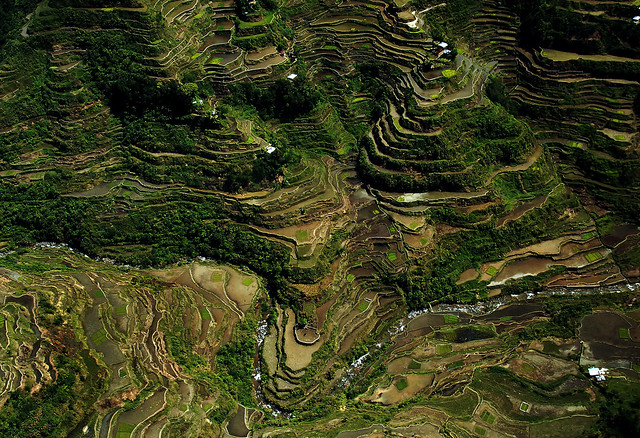
2 Banaue Rice Terraces


Situated in the heartlands of the Cordilleras mountains of the Philippines and rising to an altitude of 1525 meters (5000 ft) are the Banaue Rice Terraces. The terraced fields were carved out by hand without modern tools by the Ifugao tribes and have been producing rice for almost 2,000 years. These terraces are so numerous, steep, and compact, that if stretched out end to end, they would wrap halfway around the globe. Lately, these under maintained rice terraces have been showing their age, as more and more Ifugao tribes people are emigrating to the cities.


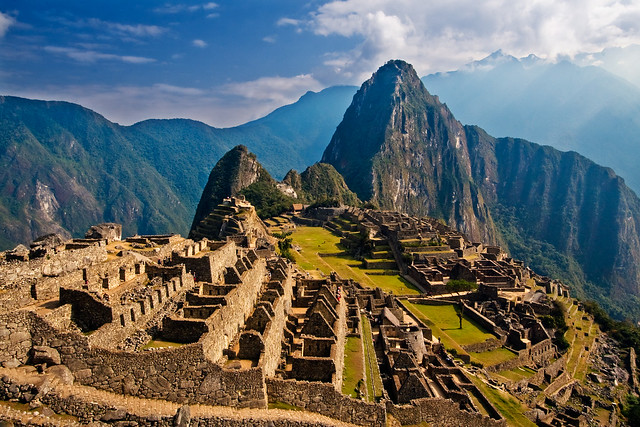
1 Machu Picchu


One of the most beautiful and impressive ancient sites in the world, Machu Picchu was rediscovered in 1911 by Hawaiian historian Hiram Bingham after it lay hidden for centuries above the Urubamba Valley in Peru. The “Lost City of the Incas” is invisible from below and completely self-contained, surrounded by agricultural terraces and watered by natural springs.
Machu Picchu’s narrow terraces were constructed from stone blocks, with thousands of pathways and steps, connecting buildings, plazas and the cemetery. Water was channeled in via aqueducts that had been chiseled into the mountainside, for livestock and to irrigate crops of potatoes and corn. There are no growing crops today on Machu Picchu’s terraces, but a spectacular site none the less.

CAO DAI TEMPLE - WHERE THE FAITHFUL WORSHIP AMONG THE TOURISTS

JUST before midnight, the monks were still arriving. Dressed in long, flowing white robes, they resembled fireflies as they rode through the darkness on their motorbikes, descending on the towering temple at the heart of the Cao Dai holy land in southern Vietnam. Many were attending their fourth service of the day.
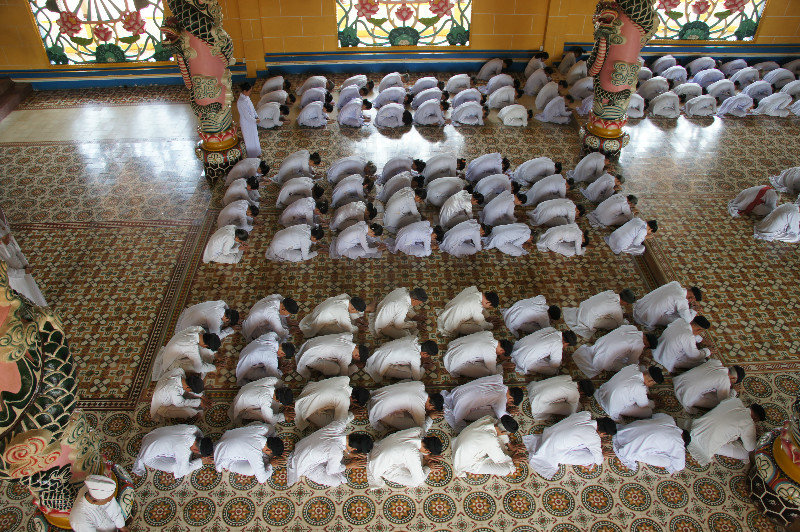
Removing his sandals and smoothing down his robes, Vo Huu Nghia, 60, who had befriended me that day last year, joined them. He silently entered the cavernous temple and, finding a spot, knelt down and began to chant his prayers. Above him were the serene faces of Jesus, Confucius and Buddha, while a giant all-seeing eye stared down at the few hundred worshipers.
“We are Vietnamese, this is our religion,” Mr. Vo told me later in halting English.
For 70 years this elaborate, dragon-adorned temple outside the small city of Tay Ninh, about 60 miles northwest of Ho Chi Minh City (formerly Saigon) near the Cambodian border, has been the center of Cao Dai, which has five million adherents. While it is not the country’s dominant religion, it has the distinction of being its largest homegrown one.
Every year tens of thousands of visitors, pilgrims and tourists, visit the temple to worship or simply to gaze in awe at its vaulted ceilings, vibrant color schemes and praying masses. And then there’s its unusual collection of saints, prophets and religious iconography, which in range, kitsch and spectacle presents an impressive cross-section of religious and aesthetic styles. But that’s befitting a religion that aims to unite all of humanity through the common vision of an individual creator — the same God honored by most major religions. The protagonist of Graham Greene’s “Quiet American” (1955) described the temple like this: “Christ and Buddha looking down from the roof of a cathedral on a Walt Disney Fantasia of the East, dragons and snakes in Technicolor.”
I had been drawn to the temple after coming across a list of Cao Dai (pronounced gao-DIE) saints that included Joan of Arc, Thomas Jefferson, Sun Yat-sen (the revolutionary father of Chinese republicanism) and Victor Hugo. This diverse group was apparently drawn from those spirits who reached out to Cao Dai priests during séances to impart wisdom and guidance. Some, like Victor Hugo, were said to have regularly communicated with the Cao Dai from beyond the grave.
Visitors to the compound today won’t see a séance — the government banned the practice in 1970s — but there is more than enough to thrill and confuse even the most temple-weary tourist.
The compound has two ornate temples, and a pope’s office, in front of which believers subjugate themselves out of reverence for the first, and only, Cao Dai pope, Pham Cong Tac. (He died in 1959 in exile in Cambodia after running afoul of the South Vietnamese government.) The 188-acre grounds include dormitories and kitchens for the hundreds of resident priests, a high school, a hospital, forests and a large area for religious processions.
I decided to forgo the $6 daily tour buses from Ho Chi Minh City for a three-hour trip by crowded public transport to the nearby town, a journey that still afforded a view of the city’s vast sprawl giving way to miles upon miles of paddy fields. Tay Ninh is in a tropical, agricultural area, and besides the Cao Dai temple and the nearby Cu Chi tunnel system left over from the Vietnam War, there is little to draw tourists.
Checking into the nearest hotel in the small, ramshackle town that has grown around the outskirts of the temple complex, I quickly headed out for what would be the first of many Cao Dai services, which are held every six hours throughout the day and night.
Inside the main temple, worshipers and priests were already bowed, their heads planted firmly on the cool stone floor as they chanted words of praise, accompanied by a single drumbeat and a few stringed instruments.
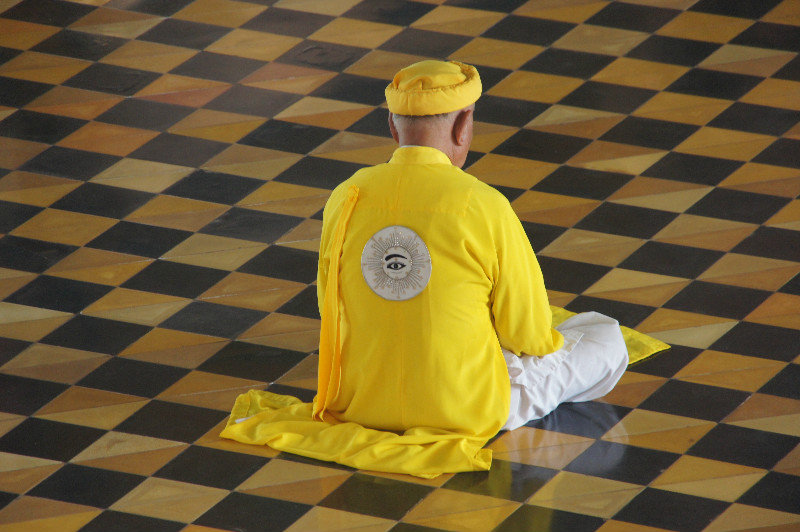
Closest to the Divine Eye above the altar, several priests in bright red, yellow and blue robes adorned with a large eye and with elaborate headdresses led the worship. On the balconies above, foreign and Vietnamese tourists watched in silence, a concession made by the temple priests, who allow tour groups in exchange for much-needed dollars. (Every day, about a half-dozen busloads of visitors come to see the noon service before heading to the Cu Chi tunnels and then back to the city.)
Thirty minutes after the chanting had begun, it was over, and with that the worshipers stood up and quietly filed out. The priests and student priests remained, enjoying the cool temple air rather than braving the outdoor heat; some went to their rooms to rest.
Soon the tourists were gone too, and the only people left beside me were a handful of sun-worn priests occupying the temple, constructed to be the center of a holy land for a religion created from the vision of a civil servant in 1919.
Today’s striking multicolor, dragon-adorned temple was built from 1933 to 1955, and in architectural terms, is part church, part pagoda, crammed with ornate drums and gongs, haloed statues of saints and other holy figures, and lavish and colorful symbols of other religions. There’s also a sphere depicting the all-seeing Divine Eye — Cao Dai’s offering to the religious cornucopia.